This blog centers around the theme of Travel.
It delves into the profound aspects associated with Travel – the way it can be perceived, sought after, and realized, or conversely, missed, avoided, and denied. These aspects remain constant, irrespective of whether we are conscious of them or choose not to acknowledge them.
Don’t expect a website filled with advice about the best routes, food curiosities in different places, or recommendations for the cheapest hotels, campgrounds, and B&Bs. This blog won’t focus on guiding skilled tourists to must-see locations or comparing travel gear to weigh their pros and cons. You won’t find tips here on collecting airline miles or financing a nomadic life with a laptop under a palm tree on the beach. There are plenty of other websites out there where you can eventually gather such information – some more helpful, others more misleading.
This blog takes a different approach. It’s all about the experience of Travel and the art of storytelling that accompanies it. It delves into the profound essence of Travel and the intrinsic urgency it brings. This is a place for exploration, for uncertainty, and for attempting to articulate why Travel calls, moves, and transforms us, or why we sometimes resist its pull. It’s a space to explore what Travel deconstructs within us and what it constructs. It delves into the existential debt Travel places upon us and how we try to repay it.
This blog delves into Travel as an encounter – an encounter that involves risk, presenting both opportunities and the potential for destruction and self-destruction.
For very precise reasons I’ll be addressing elsewhere on these pages, here you won’t find discussions about comfortable Travel – Travel seen as a mere extension of our daily domestic routine. I won’t touch on relaxing Travel, Travel as a diversion or hobby, or Travel as a holiday where the main goal is collecting IG-shareable pictures and souvenirs. To me, those types of experiences don’t align with the true essence of Travel, as it is understood in the context of this blog. Instead, they represent mere changes in position, temporary movements that have minimal personal consequences, but a massive impact on the economy, society, culture, and environment.
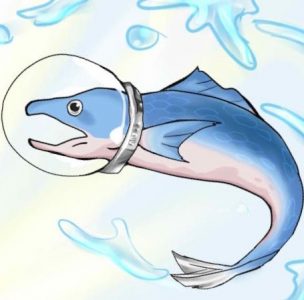
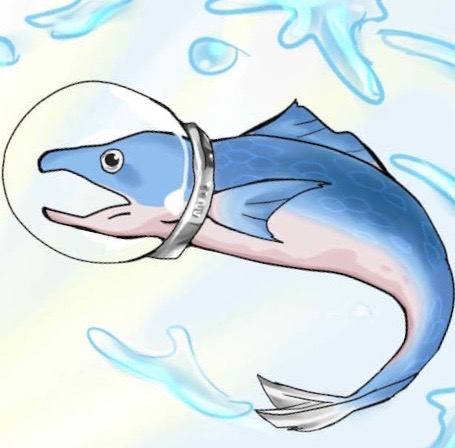
Spacesalmon is a fantastical creature, an imaginative fusion of half salmon and half astronaut, carefully chosen as my personal symbol for this research.
Salmon are born in the pristine, fresh waters of river sources. During their early stages of life, juvenile fish shun the light, slowly consuming the energy reserve from their eggs, and make their way downstream, learning the art of self-sufficiency in feeding. Upon reaching the vastness of the open sea, they transform into pelagic creatures, navigating freely and fearlessly through the ocean’s depths. Born in the shallow rivers, they now roam the wide oceans with ease.
As they reach sexual maturity, the time of mating arrives, marking the beginning of their second journey, which is no less perilous than the first. Remarkably, salmon possess the ability to recognize the correct path leading back to their native river, even if it requires swimming thousands of miles. Guided by their keen sense of smell and the mental map absorbed during their initial descent, they find the river mouth and commence the arduous journey upstream, a feat that will ultimately cost them their lives.
For many of these resilient fish, success will elude them. They will fall victim to bears, wolves, foxes, and eagles. Artificial barriers will halt their progress, and humans, unaware of the magnitude of their endeavor, will catch them. Throughout this journey, they will forego feeding, propelled solely by the thrill of their epic quest. They will deplete their entire fat reserves and even their muscle fibers to reach their goal.
Their journey is a Return.
A Return implying a profound transformation, signifying their transition to adulthood. Yet, it remains an illusory Return, as they reach the source – the very origin of their biological existence – to fulfill the vital cycle, condensing their last bursts of energy into genetic code and nourishment for the successors of their species-project.
They are prepared to sacrifice themselves for this purpose, prepared to die in the act of Return. As we well know, ποταμῷ γὰρ οὐκ ἔστιν ἐμβῆναι δὶς τῷ αὐτῷ – “You cannot step twice into the same river” [1]. Hence, even their Return is an illusion. Similar to déjà-vu, which creates a false impression due to a fleeting glitch in our memory when processing an experience, salmons rediscover their river with a sense of wonder. It is a familiar discovery, uncovering the ancient within the new and the new within repetition.
In the Travel I aim to narrate, the search for déjà-vu holds symmetrical significance of paramount importance. It is meticulously organized, and its path will lead through uncharted territory, experiencing heartbeats of events never encountered, meeting eyes and hands of people yet unknown.
In this Travel I yearn for nothing more than to encounter “always the one, shape-shifting yet marvelously constant story” again, to see it, read it, and live it anew. [2]
[1] Heraclitus, Fragment 91 as quoted by Plutarch, On the EI at Delphi
[2] Joseph Campbell, The Hero with a Thousand Faces
 spacesalmon